
Mission, TX · Garage Door Service
Garage Door Service for Mission's 1990s Housing Stock
Mission homes built mostly 1987-2005 are hitting original torsion spring end-of-life right as severe summer heat accelerates wear. Here's what that looks like and what to check first.
- Repairs & new doors
- Springs & openers
- Serving 5 nearby communities
How It Shows Up
The door starts slow on the way up, or it jerks partway through the cycle instead of gliding. You hear a grind or a dull thud from one side of the track as the rollers catch. The opener motor runs longer than it used to, straining on the last foot before the door seats, and sometimes it reverses on its own for no obvious reason. On the hottest afternoons the door can feel noticeably heavier to lift by hand than it does in the early morning, because the torsion spring that's supposed to carry most of that weight has lost tension.
In a lot of Mission houses, this shows up first as a loud bang. That's a torsion spring letting go, usually a cable-snap sound that most owners describe as a gunshot in the garage. If that's already happened, the door won't lift at all, by hand or by opener, and it shouldn't be forced. Before that point, the warning signs are quieter: uneven gaps along the bottom seal, a door that won't stay up when you pull the release cord, or an opener logic board that resets itself mid-cycle on a hot day. Any one of those on its own might be nothing. Two or three together usually mean the spring system is nearing the end of its working life.
Why It Happens Here
Most of the housing stock around Mission went up between 1987 and 2005, with a median build year around 1997 across the area's named neighborhoods. That matters because a standard torsion spring is rated for roughly 10,000 to 15,000 open-close cycles, which works out to something like 20 to 30 years of normal household use depending on how often the door gets run. A huge share of Mission garage doors are sitting right in that window now - installed with original hardware during the same decade and a half of growth, aging out on roughly the same schedule.
Severe heat speeds that timeline up. Steel spring wire loses tensile strength faster when it's cycling through high daytime temperatures year after year, and the grease packed into the coil breaks down quicker in sustained heat than it would in a milder climate. Nylon rollers and plastic idler bearings get brittle under the same conditions and start cracking instead of wearing evenly. So the same house that was built with code-standard hardware in, say, 1996 is now carrying springs and rollers that were never meant to last past the mid-2010s, pushed along faster by the heat they've sat in every summer since. That combination - original-era hardware plus a severe-heat climate band - is why so many service calls in this area cluster around spring fatigue and roller failure rather than, say, opener electronics or panel damage.
Where This Job Goes Sideways
The mistake we see most is someone replacing one spring on a double-torsion-spring door and leaving the other, assuming it's fine because it didn't break. Springs installed the same year wear at close to the same rate. Running a new spring against an old, weakened one puts the door out of balance, which shows up as exactly the opener strain and crooked travel described above - except now it's a new-looking fix that still doesn't work right.
The other place it goes wrong is diagnosis. A logic board that resets on hot afternoons can look like an electrical fault, but on an older opener paired with a tired spring, the motor is working overtime trying to compensate for lost spring tension and the board is protecting itself by cutting out. Replace the opener and the symptom often comes right back, because the spring was the actual problem.
With 43,024 owner-occupied houses in the broader service area and a median household income under $49,000, a lot of owners are weighing repair against replace on a tight budget. That's a fair question to ask, but it only gets answered correctly once the spring, cable, and track are actually inspected together - not from a phone description of the noise.
The DIY Question
Lubricating hinges, tightening loose bolts on the track, and cleaning the photo-eye sensors at the bottom of the track are reasonable DIY jobs, and doing them twice a year actually slows down the heat-driven wear described above. That's real maintenance and it's fine to do yourself.
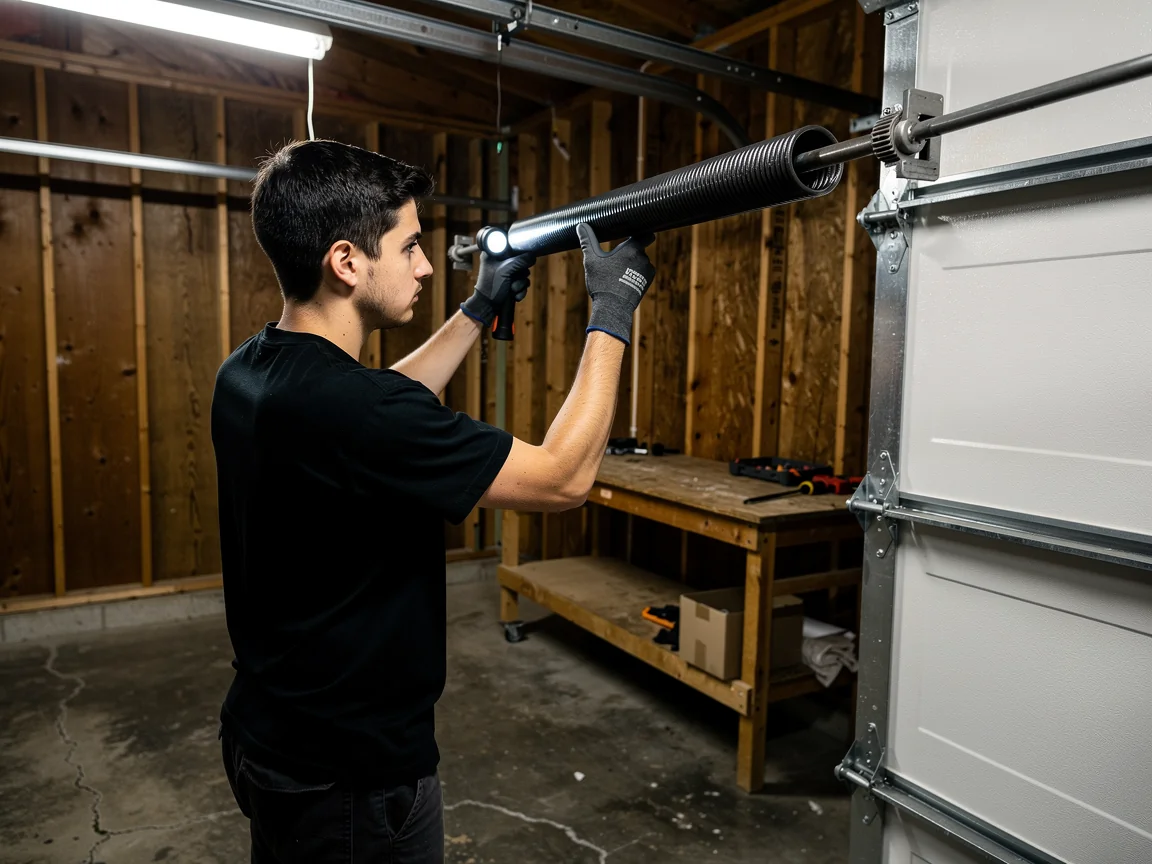
Torsion spring replacement is not. The spring is wound under enough tension to break bones or worse if the winding bars slip, and getting the tension wrong on a rebalance leaves you back at the opener-strain problem within weeks. We won't talk anyone through doing that one over the phone, and that's not us protecting a job - it's the same thing any honest shop will tell you. If the noise you're hearing is a grind from a dry roller, grab the lube. If it's a bang, a door that won't budge, or a visible gap in a coiled spring, that's a call, not a project.
Frequently asked questions
Is my garage door spring actually old enough to be the problem?
If your house was built in the 1990s or early 2000s and still has its original spring, yes, it's a strong candidate. Torsion springs are rated for about 10,000-15,000 cycles, which lines up with 20-30 years of normal use, and Mission's severe summer heat tends to shorten that window rather than stretch it.
Why does my door seem heavier in the summer?
Heat breaks down the lubricant inside a torsion spring's coil and softens the spring's tension over time, so it carries less of the door's weight than it did when new. The door isn't actually heavier - the spring is just doing less of the lifting, and your arms or the opener motor are picking up the slack.
Can I just replace the opener if it keeps cutting out?
Only if the opener itself is the fault. On older homes with original torsion springs, a motor that strains and a board that resets on hot days is often the opener compensating for a weak spring, not an opener problem. Swapping the opener alone usually brings the same symptom back within a short time.
Book garage door service in Mission
Call now or request a quote - tell us what the door is doing and where you are.